The war between Helium and Zodanga
A Princess of MarsThe war between Helium and Zodanga is the political and military conflict that brings John Carter’s rescue of Dejah Thoris into alliance with Tars Tarkas’s campaign against the red Martian kingdom. Its decisive turn is the partnership between Helium and the Tharks: green warriors who had been feared as enemies march in overwhelming force against Zodanga, seize its capital, and help break its siege of Helium. The outcome is a dramatic military victory, but the campaign’s aftermath also reveals the destruction and predation that accompany it.
Causes and Stakes
The conflict has a history beyond Dejah Thoris’s captivity. Zodanga had waged a ruthless campaign against the green Martians for years, directing particular attention toward their incubators. That history helps explain why the Tharks’ longstanding hatred of the red men can be redirected toward Zodanga, even though the green warriors are not initially fighting for Helium’s political cause.
The immediate crisis is the proposed marriage of Dejah Thoris, Princess of Helium, to Sab Than, the Prince of Zodanga. Than Kosis, Zodanga’s ruler, has made her marriage to his son the price of peace between the countries. Helium’s ruler, Tardos Mors, refuses to accept the demand: he would rather face his city’s destruction than have Dejah Thoris married against her choice. The dispute thus joins national sovereignty and the threat of war to the princess’s captivity and prospective forced marriage.
Dejah Thoris’s account of the Helium expedition gives the conflict a broader environmental and political dimension. She explains that the expedition was a peaceful scientific mission to rechart air currents and measure atmospheric density, and argues that Helium’s work helps preserve the air and water supply on a dying planet. Her appeal urges the green warriors to abandon enmity and join the red Martians in sustaining life on Mars. The council is visibly moved, and Tars Tarkas appears to struggle against inherited custom, but the moment does not itself bring about an alliance. The war’s eventual coalition is forged through military and political opportunity as well as any appeal to fellowship.
From Captivity to Alliance
After John Carter reaches Zodanga, Kantos Kan tells him that he has been there three days trying to discover where Dejah Thoris is imprisoned. Kantos Kan has joined the Zodangan navy as an air scout, hoping to win Sab Than’s confidence and learn her whereabouts. He also explains the refusal of Tardos Mors to consent to the marriage, making clear that Helium regards the proposed union as an intolerable surrender rather than a peaceful settlement.
The decisive change comes after Tars Tarkas becomes leader of the Tharks. He makes Carter a full-fledged chieftain, recognizing the rank Carter earned through combat during his captivity. Carter then persuades Tars Tarkas to support an expedition against Zodanga, and Tars Tarkas presents the proposal to the council as a plan to rescue Dejah Thoris and return her to Helium. He also emphasizes the prospect of Zodanga’s immense loot and the potential benefit of an alliance with Helium: access to sustenance that could allow the Tharks to increase the size and frequency of their hatchings. The council accepts the campaign as an opportunity for both battle and plunder.
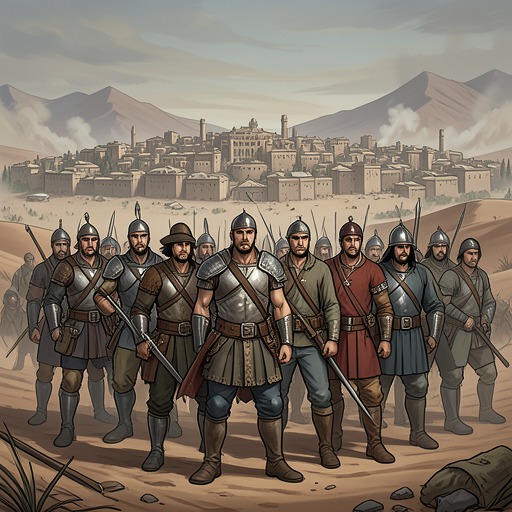
The force grows with astonishing speed. Within half an hour, mounted messengers are crossing the dead sea bottoms to summon the hordes. Three days later, one hundred thousand warriors begin the march; Tars Tarkas recruits another fifty thousand from other hordes along the way. They travel by night and shelter during the day in deserted cities, keeping even their animals indoors. Ten days after setting out, the army halts outside Zodanga with one hundred and fifty thousand warriors. Tars Tarkas’s political skill keeps the immense force together despite internal rivalries, while the Tharks’ hostility toward Zodanga helps suppress their quarrels as they approach the city.
The Fall of Zodanga
Carter leads a small party into the city by scaling its great wall. Ten warriors form a human stairway, allowing him to reach the top; he then lowers joined lengths of leather down the other side and descends to the pavement. Having learned from Kantos Kan how to open Zodanga’s gates, Carter gets his twenty fighters inside. He recognizes that he has entered near the lower boundary of the palace grounds and decides to send a detachment toward the palace while the main horde attacks the soldiers’ barracks.
The palace assault is planned to remain quiet until Carter’s force is in position. He sends a messenger to Tars Tarkas asking for fifty Tharks, then divides his existing men between two gates, ordering them to open the entrances without firing or starting a general advance. The sentries and gate guards are killed silently, and the plan succeeds. The incursion brings the outer conquest directly into the royal ceremony at the center of the conflict.
Carter sees two veiled figures brought before Than Kosis. When the coverings are removed, one is Sab Than, and the other is Dejah Thoris. The ceremony is about to bind her to the prince. Carter smashes the great window with his sword hilt, enters the hall, and cuts the golden chain that would have joined her to Sab Than. Sab Than attacks him with a jeweled dagger, but Carter seizes his wrist rather than killing him, restrained by the customary prohibition against killing a member of the opposite sex. He then points the assembled court toward the news that Zodanga has fallen. The interruption does not merely rescue Dejah Thoris from the marriage; it makes the military defeat of her captors visible at the very moment their political settlement is being enacted.
Victory and Its Cost
Tars Tarkas and Kantos Kan later report that Zodanga has been completely reduced: its forces are destroyed or captured, and no further resistance is expected from within the city. Several battleships have escaped, but thousands of warships and merchant vessels are under Thark guard. The lesser hordes, however, begin looting and fighting among themselves. To avoid losing more time to their disorder, the allied leaders gather the warriors they can, put Zodangan prisoners aboard the vessels, and set out for Helium.
Five hours later, a fleet of two hundred and fifty battleships carrying nearly one hundred thousand green warriors leaves the roofs of the dock buildings, followed by transports carrying the Tharks’ thoats. The victory has not produced a controlled or humane occupation: some forty thousand warriors from the lesser hordes remain in Zodanga, looting, murdering, and fighting, while fires send dense smoke above the city. The same coalition that has enabled the rescue and the march to Helium leaves devastation behind it.
At Helium, the returning force meets the Zodangan fleet that has been besieging the city. Green warriors open fire as their ships rise, and Helium sends hundreds of vessels to support its allies. In the later land engagement, the Tharks face a Zodangan force of nearly a million fighting men, while fewer than one hundred thousand green warriors hold the opposing line. The battle turns when heavy firing announces the arrival of Helium’s much-needed reinforcements. Tars Tarkas orders another charge; his warriors attack the Zodangan ramparts as Helium’s forces surge over the opposite breastworks, crushing the defenders between them. Zodanga’s remaining soldiers eventually surrender, and the prisoners are marched back to Helium.
The New Political Order
The campaign changes the meaning of the Tharks’ arrival at Helium. They enter as armed allies rather than invaders, a reversal that astonishes the city because no armed body of green warriors had previously passed through its gates in friendship. The people greet the victors with applause and shower them with ornaments of gold, platinum, silver, and jewels. Public celebration gives visible form to the alliance that military necessity and shared opportunity have created.
The peace achieved is therefore both consequential and unstable in its foundations. Helium and the Tharks have defeated their common enemy and brought Dejah Thoris back from the threatened marriage, but the alliance was promoted partly through the promise of loot and the prospect of increasing Thark hatchings. Zodanga’s defeat also produces prisoner-taking, mass violence, and uncontrolled plunder. The war’s resolution joins rescue and political cooperation to the same martial force that leaves a conquered city burning, making victory a transformation of allegiance rather than an end to the story’s violent customs.